
825 – 848 ASF
When I confronted Lorekeeper Chrasse in the Raven’s Nest, he beheld me with wide eyes, a quivering lip, and a face drained of blood—as if I were the ghost of a long-dead creditor. He made no denials as I connected the dots right there in front of him, accusing him of selling his University brooch and stealing my money. But before he could offer up a defense, there was a metallic bang.
The game of chance had begun. All at once, the raven keepers opened the cages. The birds burst free from within, soaring outwards from the chamber and into the halls beyond. Lorekeeper Chrasse sprung into a dash after the bird he had bet on, as did everyone else. I rushed after Chrasse as the crowd boiled into several stampedes, following their ravens, screaming at them, egging them on. I winced as elbows and knees jammed into me, but I fought to stay on the tail of Chrasse and his raven. The madness spread all throughout the Raven’s Nest. Onlookers joined in the chase or retreated behind guards, who kept the frothing masses from spilling onto other games.
The ravens circled and swooped like hawks hunting for prey. Chrasse’s raven, however, alighted onto a great raven statue. Then it preened itself with an air of indifference, despite Chrasse and other’s pleading that grew steadily more deranged. At last, there was a monumental cheer that echoed across the Nest. I turned to see The Scythe soaring back to the starting point, a jeweled ring glinting in its beak. A triumphant crowd hooted in its wake.
I had just witnessed my first game of Raven’s Eye. And, judging by how Chrasse’s face whitened even further, I had just lost it, too.
There is a saying in Rivona that survives to this day, a shadow that has followed its culture through the ages. It is whispered like a curse when your child dies in the cradle. When your sheep and cows fall sick in the fields. When your crops fail, the rivers flood, or a swamp fire burns down your home. Or, perhaps, when you lose all your money in a game of chance.
Whenever ill luck and dark omens fall over you, it is said that the Raven has roosted in your house.
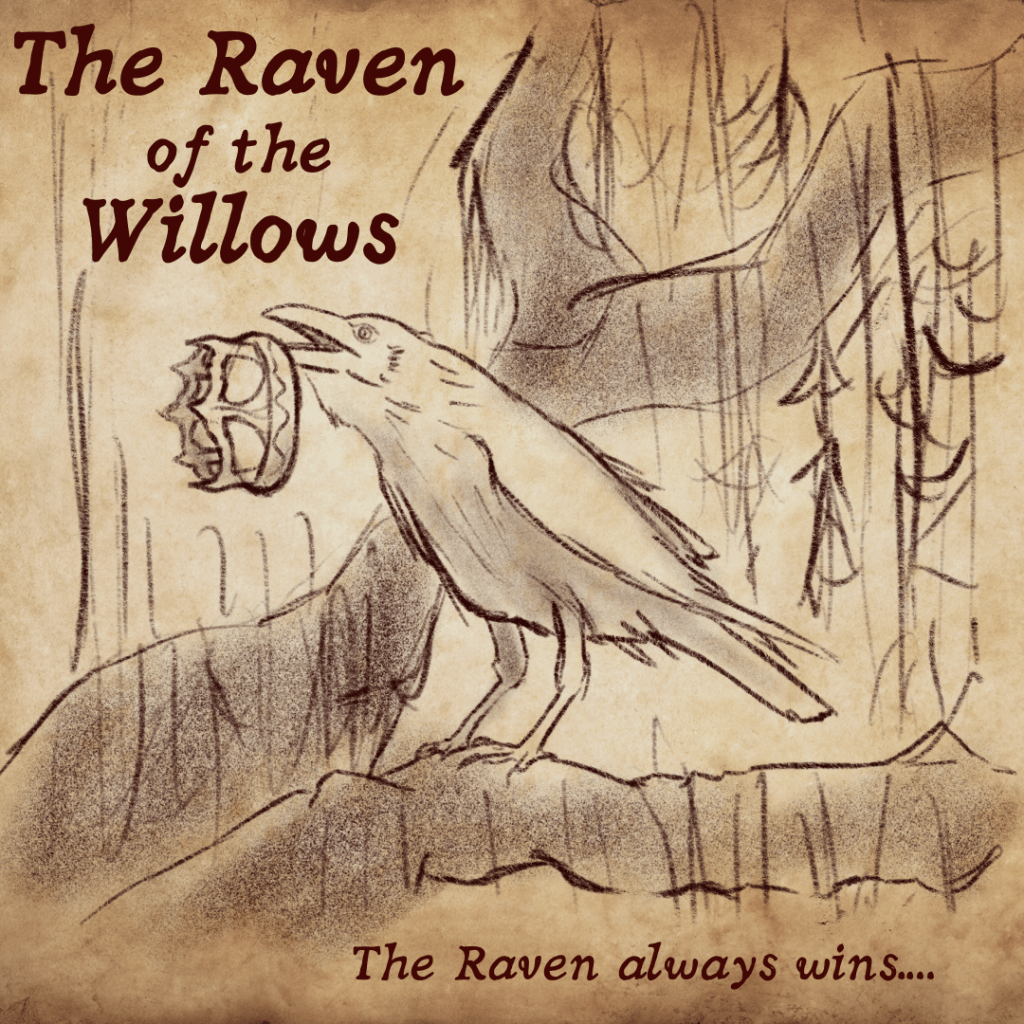
Not just any raven, but the Raven of the Willows. According to most accounts, she is an old woman, crooked and hooded, her robes never clean and tattered with marsh muck and feathers. She has always lingered in the gloom of Rivonan history and folklore. Her appearances in tales—where she offers riddles to those she favors and curses to those she doesn’t—predate and succeed Rugon by centuries. She is either a creature older beyond reckoning, or a figure assumed by multiple people over time. Regardless, Rivonans fear and respect her as something of a god, one who walks with the rivers and the ravens.
In short, you do not want the Raven roosting in your house.
As she did, when ill fate and utter defeat befell Rugon at the Blackrush Massacre. But dark luck lingers like a miasma, Rivonans believe, and the king soon experienced this himself. More rebels and defectors fled his kingdom, on the verge of forming into rogue states. More flooding. More swamp fires. Rugon spiraled deeper into desperation, taking more reckless risks with money and resources and people, most all of which failed. We, as did his court and his family, must ask: why? Why, when most of his winnings remained intact?
Rugon’s despair surged to a new height when his eldest son was thrown from a horse, breaking his neck in the fall. A freak accident…or the shadow of the Raven? Something changed in the king then, and it wasn’t just grief, but a doomed, dark look in his eyes, reported by servants and his wives and everyone in between. The look of a man who knows his luck has abandoned him, never to return.
Perhaps this is why he leashed in his second son and heir, Rykar. Upon him, Rugon dumped a deluge of lessons, instructions, and advice—things previously passed over to the late heir. This only alienated Rykar, who had grown used to his freedoms as second-in-line and the bloodlust bred into him by his father. This only made Rugon cling tighter, like a drowning man clinging to driftwood—but to no avail.
Rugon soon came down with a scalding fever, frigid goosebumps, and a cough that produced something like bloody swamp silt. When he was told he had contracted marsh chills, a disease with no cure, he said words that would continue to ring through a thousand years of Rivonan history.
“Death shall not claim me. I shall claim death.”
In 848 ASF, King Rugon Craythe, aged 71, ordered the construction of the first ever burial ship, upon which he was fastened. Then, after Rugon attended his own funeral, his family and friends sent him over River’s End, the greatest waterfall in all of Rivona.
Lorekeeper Chrasse and I weren’t quite at that point yet, but we were far from well-to-do. His gamble on a raven named Rugon (but of course) had swallowed not just all of my money, but all of his as well! I would have been furious if I hadn’t started panicking. How would we pay for food? Lodging? Supplies? To say nothing of a charter back home to the University?
Chrasse apologized over and over, claiming he owed a debt to someone as greedy as a dragon, and he’d run out of alternatives. We left the Raven’s Nest, emerging back onto the city and finding a quiet spot on a bridge. Here, Chrasse finally calmed me down, saying he’d think of something to get us home. His chief worry was that I was going to tell everyone about this, and pleaded me not to.
After some thinking, I agreed to keep quiet—on three conditions. First, that he would get my money back. Second, that he would not go back to the Raven’s Nest on this trip. And third, that he would tell me Rugon’s secret. He didn’t like any of this, but I now possessed knowledge that could cost him his career, if not more. He furrowed his brow, ground his teeth, mashed his lips together, and then finally gave in.
Among the University’s most prized artifacts, he explained, was a diary entry from one of Rugon’s wives, written just before the king’s death. In it, she wrote about how, in his final hours, the king shared a secret with her he had been carrying all of his life. It was this:
Rugon had met the Raven as a child lost in the swamp. Instead of playing a game of riddles with her, he’d gambled. Gambled his own life that he could escape. And when he did, he won something from the Raven herself: a piece of ancient wisdom from the rivers and ravens. This higher knowledge of the riverlands was supposedly the secret to his success, to all of his “good luck”. For example, during his conquest, rival chieftains thought they could escape and hide from him within the Lost Rivers, the one of the most inhospitable and confusing corners of Rivona. Supposedly, Rugon used this wisdom to track his enemies through the watery maze. To find them. To corner them. To execute them. Each and every one.
To Rugon, this supposed ancient wisdom became an unquenchable thirst. Over the years, he kept coming back to the Raven for a new gamble, for more ancient wisdom. Again and again and again, sometimes for strategic purposes. Sometimes for the thrill of it. Sometimes out of desperation.
He’d gambled anything and everything. Resources. Seats of power. Vast sums of money. Bigger boats. People, too—subjects, allies, even his own family. Gambling and gambling, until he’d won all of the riverlands and become Ruthless. He didn’t always win across the board, of course. For example, he wagered with the Raven that he could conquer the riverlands in five years. He did it in just under six—and the price, it seems, was his firstborn son.
After ascending into kinghood, his losses just kept coming—out of his own complacency, or arrogance, or simply because over time, the Raven always wins. The Blackrush Massacre, which he’d bet on being a victory, was the tipping point, and his penchant for winning never returned. His pile of debt to the Raven grew ever higher with each loss—until at last, she came for him, roosting not in his house, but in his very blood and flesh.
This is what Rugon and his wives believed, at least, but how much of this is actually true? It is difficult to say. Perhaps the story of Rugon is just one of ruthless ingenuity and a heap of luck, both good and bad. Or perhaps the Raven did play games of chance after all. Unfortunately, she isn’t one to show up and answer questions.
Lorekeeper Chrasse was a believer, naturally. He told me that he was trying to solve his problems the same way Rugon had, so I could spare him my judgement. And, he reminded me, Rugon’s secret belonged to the University. I was not to share it without express permission (which, even as I write this, I never obtained). So, Chrasse concluded, I should carry on and pretend none of this had ever happened. Gratefully, he added.
Gratefully? Indeed. How we untangled ourselves from that mess is a story for another Volume. But at that time, I did know one thing. Like Rugon, perhaps, I had gambled, even if it had been involuntary. I had lost, yes, but I had also won. I was now a player in the game, and had no idea when I’d get out.

Leave a comment