
Subscribe to continue reading
Subscribe to get access to the rest of this post and other subscriber-only content.
Subscribe to get access to the rest of this post and other subscriber-only content.

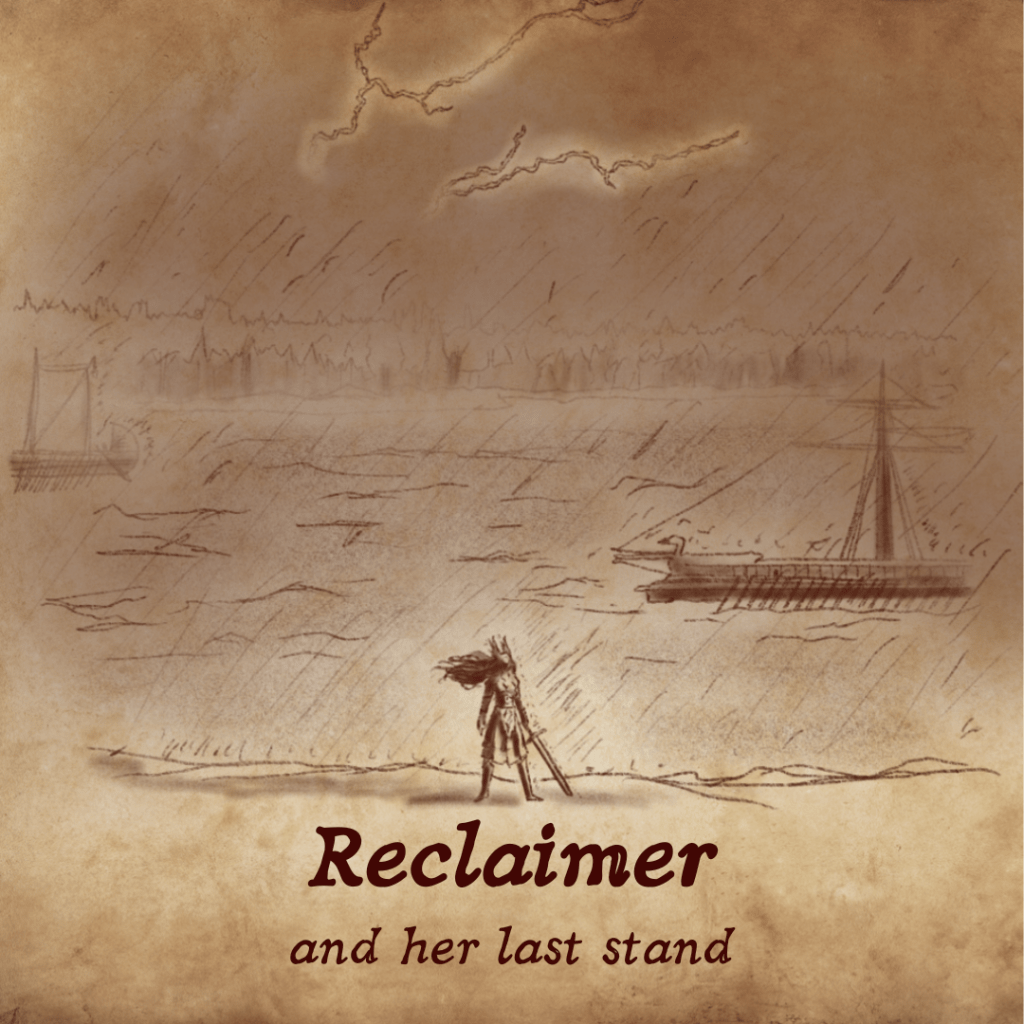
Along with gambling, superstitious tales, and lynching riverbirds, another time-honored tradition of Rivonan culture is showboatsmanship—literally. Even to this day, watercraft are used as symbols of status and power. And Relga Craythe used this to great effect when she made her grand entrance into Rivonan society, sailing into Great Forks on a vessel she had built herself; one that could withstand the open waters of Lake Liron. In doing so, she spoke a language—made a statement—that turned the heads of everyone in the country.
Not everyone immediately believed she was the twenty-eight-year-old lost princess of Rogar Craythe, returned to claim her throne and lead her country in war. She had the looks, yes—the signature misty eyes, tumbling raven-black hair, and high cheekbones of the royal Craythe line—but the nobility demanded more evidence, to which she presented the royal signet of the late Kerraguard-Captain Harland. To seal her credibility, the White Crow stepped forward and affirmed the claims, revealing her conspiracy with Harland to keep Relga hidden.
Even as more believed in Relga, a solid core of the nobility resisted the idea of allowing a woman alone to rule. Writing from the year 1642 ASF, with many women of the world interspersed across many professions (I’m one of them!), it is easy to forget how society viewed and treated women up until Relga. Her actions (as we will soon see) spurned the wheels of change that slowly, over many generations, shifted minds and hearts to what they are today.
To those nobility who resisted, Relga asked them a simple question: who else? There were no other Craythes, no other descendants who had as strong a claim as she. And what had the nobility done, after the death of the last king? Squabbled amongst themselves, fought for scraps, looked out for none but their own, all while the Bear and Doe pressed further and further in at the borders? Each year their enemies pulled the noose tighter around Rivona—slow, patient, one calculated step at a time—until one day their armies would be at the walls of Great Forks. Again Relga asked: who else but she, with her lakefaring vessel and a plan to hunt the Bear and Doe and mount them on the wall?
Few could argue with this, or with the first step of her plan: to build a lakefaring fleet, blending her designs with those of Great Forks’ shipwrights. It was a gamble with Rivona’s dwindling resources, including Relga’s own crown. Indeed, she skipped out on her own coronation ceremony, choosing instead to pour the resources into more lakeships.
To crew her growing fleet, Relga welcomed anyone old and able enough to fight—even women, many of whom were inspired by the returned queen. Her forces bolstered and her ships manned, Relga sailed out into the open waters of Lake Liron, beyond the sight of land. Then, using the stars for guidance, she pointed her fleet northwest, towards the Khorven coastal city of Malvut. By doing so, she slipped past the bulk of Khorven’s army and the eyes of their scouts—so that when her lakeships landed, Malvut was caught by utter surprise. Relga was the first off the ships, leading her forces straight to the lord of the city. After butchering him, she looted the city for all its worth and then, before Khorven’s army could respond and retaliate, escaped back into the open waters where none could follow.
A thorough and undisputed victory for Relga—but a victory not unlike those of her ancestor, Rugon the Ruthless. The first king of Rivona had used a similar strategy with his revolutionary riverships of war, raiding and pillaging and withdrawing before ground forces could arrive. Now Relga was applying it on a grand scale—for good or ill. One thing was different, though: Relga was not fighting for glory, sport, or conquest. First and foremost, she went to war for the rivers and ravens, to protect the wilds that had formed her, nurtured her, raised her.
I understood Relga’s connection a bit better as the Conquest trundled up the Snakeshallows. The riverlands are home to many sounds: wind in the willows, the squawks of ravens and storks and everything in between, a chirping orchestra of toads and insects, among much else. But every now and then a fog would settle in, blanketing the sky, gathering between the trees, slipping into your every breath, and the riverlands would fall into an ominous silence. One that seemed to be watching. Listening. As if you spoke out to the riverlands, something might answer.
My chief suspicions weren’t with the riverlands, though. After Captain Meskani’s words yesterday, I began stealing glances at her—and the more I observed, the more I noticed strange behaviors. How she only entered or exited her cabin when she thought nobody was watching. How she yelled orders at everyone except her first mate, the Khorven man, whom she only spoke to with a low voice, often with a gesture towards her cabin. How, when we made a short stop at Crosswater, and guards came aboard to inspect the cargo for illegal goods, she hovered near the cabin, puffing frequently from her pipe.
Meskani was hiding something, I decided. And whatever it was, it was inside her cabin.
If the rest of the crew held suspicions, they didn’t show it. Instead, they spun the gossip wheel round and round, except now it was featuring more and more ghost stories and dark ales, what with nothing but wild, dark riverlands in all directions. Late at night, they spoke of Relga and the Raven, of course, but also of stories of murder, betrayal, and curses; of darker creatures that stalked the wilderness. Soon most of the crew were glancing twice over their shoulders, keeping the lights on, and whispering during the night hours. Myself included.
So you can imagine the unrest when Captain Meskani announced the herthe would be taking the route to Lone Fork—undoubtedly one of the most haunted waterways in Rivona. Even if you didn’t buy into the superstitions, one wrong turn could land you in the Lost Rivers, a graveyard of watercraft. But Meskani doubled down, saying that Lone Fork charged half the dock tax as Wetwood Cove. If they passed through that port, it would eat up all their profits. Lone Fork was their only option—and she’d kick any more fearmongerers off her ship.
I was no seasoned riverman, but this choice seemed…odd. More and more I wondered what was in Meskani’s cabin, and how it was affecting our course through the backwaters of Rivona.
But even these backwaters Relga wished to protect in her war against the Bear and the Doe. With her fleet of lakeships, she could strike along Khorven and Faela’s coasts without warning. With each victory, she poured the spoils of war back into her fleet and the defenses of Great Forks. With each victory, her fame and strength grew.
The Bear and Doe soon learned her tactics, moving their armies so that they could more quickly respond to Relga’s raids. But this played right into Relga’s hands. She, in turn, shifted her own tactics, sending ships manned by skeleton crews within eyesight of enemy ports. A feint. As Khorven and Faela rushed their armies to respond to the bait, Relga launched full-on ground assaults against the land they left behind—pieces of Rivona’s old borders. One by one, the queen reclaimed her country.
To Relga, this was all dizzying. Exhilarating. The power amassing around her was like the currents of Lake Liron—rising suddenly from deep below, propelling her upward, forward. But soon she grew used to the thrill. Craved it, even. Some legends go as far to claim Relga never once sat on her throne, so busy was she. Perhaps, however, it wasn’t the rush she craved, but the Rivonans that flocked to her. Relga surrounded herself with them at all times. She charged into battle with them, drank to their good health in feasting halls, and even pulled some into her bedchamber.
Was she simply seeking thrill and pleasure, or something deeper? Was she accounting for something missed in her childhood? Whatever it was, Relga hungered for it.
I couldn’t read anymore about Relga at this point. I needed to know what inside Captain Meskani’s cabin, and not just because of my traitorous curiosity. I had the creeping feeling something illicit was going on under the covers. Illegal goods, maybe? If Meskani was transporting something like Dreamer’s Powder and was caught, everyone on the ship would get locked up for life. I’d sooner throw myself off the ship and take my chances in the riverlands.
In this regard, the Captain’s choice to take the Lone Fork route proved useful. One night along that far-flung river, a heavy fog descended down upon us, submerging everything in muffling, prickly dark. The crew were shouting things about omens and curses, but I could hardly hear them. I couldn’t even see my own hand in front of my face. It was perfect. When the captain left her cabin, off to go shush her crew, I slipped over to the door under the cover of night and fog.
I had only planned to crack the door and peak inside. I did just this, but then my eyes caught movement along the side wall inside. Chains rattled from within. There was a muted grunt, the sound of someone trying to speak through a gag.
I pushed my way in and beheld what I assumed was the true cargo of the Conquest. A big man, his skin a splotchy pale blue and white, with antlers growing out of his skull. He was stripped to just his simple trousers, his arms and legs chained to the wall. Gagged and blindfolded, too.
I froze. Who was this? A wanted criminal? A prisoner? A slave?
Before I could determine an answer, the door to the cabin opened, and the wind blew in the smoke of the captain’s pipe.

The first night on the herthe, Newke died.
Nobody had actually seen him go overboard. The captain’s best guess was that, at some point in the night, he’d got up to piss and had accidentally toppled over the edge of the herthe.
The whole affair set my already unsettled nerves ajitter. Newke had been a new crewman, just like me. Was I next? I couldn’t imagine how Newke had lost his balance, even while tipsy. The herthe, a merchant ship named Conquest, with a dark squarish hull designed for carrying cargo, was like a turtle in the water: slow, but steady. Which was all the more impressive when I realized the herthe was being pulled upriver.
Two creatures were harnessed to the bow of the Conquest, like horses with a carriage. They spent most of their time underwater, trundling along the riverbed as they tugged the herthe against the gentle current. I jumped and gawped the first time I saw them surface. Twice as big as bulls. A pudgy, powerful body covered in slick, blackish-brown fur. A giant, flippered tail. Round ears, whiskers, and massive rodent teeth that could split floating tree trunks in two—something they seemed to enjoy doing whenever one floated by.
These were hershon, who naturally spend half their lives pushing up Rivona’s rivers, where they mate, birth offspring, and die. The other half of their lives they float lazily back down the rivers, seemingly just for the hells of it, only to do their aquatic hike all over again. Some smart Rivonan figured out how to convince them into pulling a boat while they did so, and here we were today.
So how had Newke tumbled off a stable, slow-moving barge? Rumors abounded, and I soon learned that a herthe was a pit of gossip deeper than a Rivonan village. But why? Well, the herthe held about two dozen crew. When navigating around tight corners, through whitewater, or across other hazards, every hand was needed. But the river wasn’t like this most of the time, so the crew filled the time by drinking, gambling, and, of course, gossiping.
Some people blamed Newke’s death on the man himself. His ill luck in life had followed him aboard, some claimed. Others thought it was because he hadn’t waved to riverbirds the herthe had passed on the riverbank, or simply because he didn’t know how to swim. A whispering minority thought it was because of the captain and the route she’d chosen—up through Crosswater, between Willowmere and Mistmire, long believed to be regular haunts of the Raven.
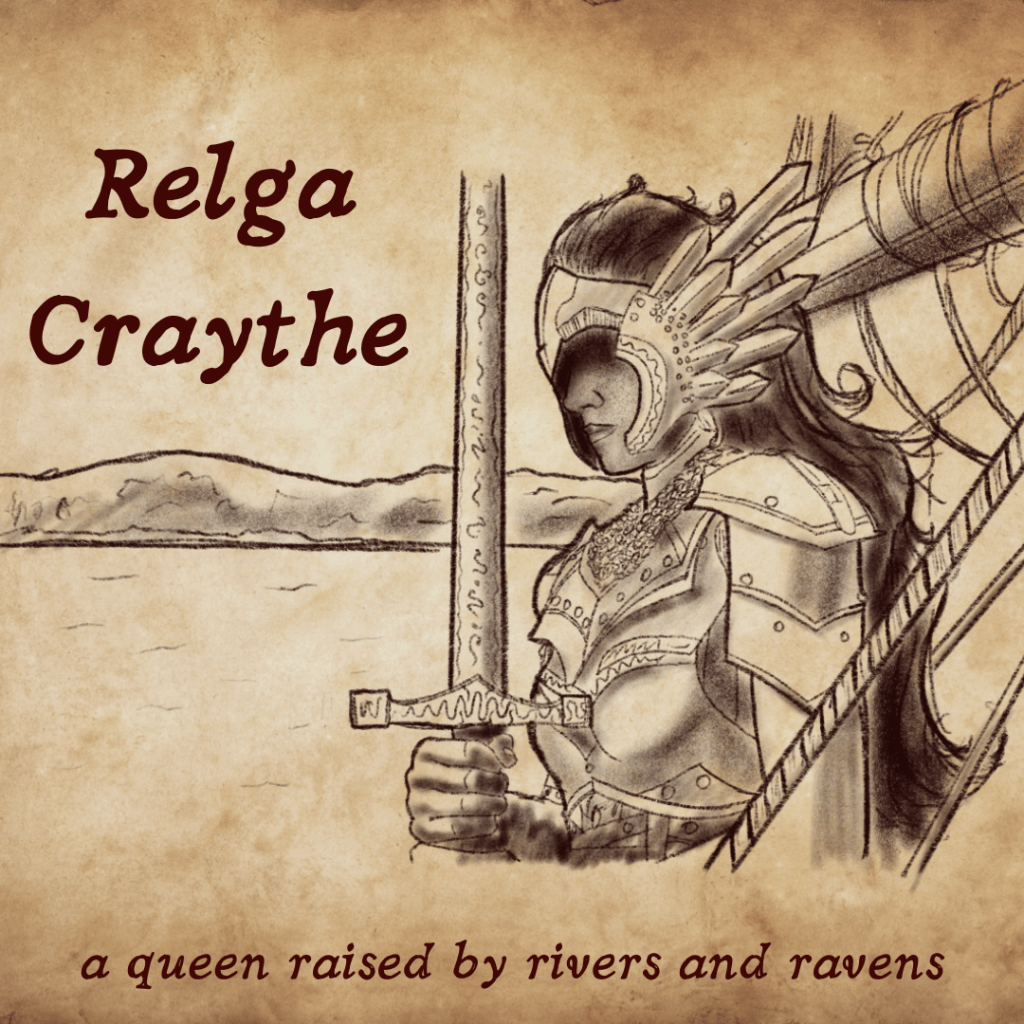
This was the same place, according to Kerraguard Exemplar, that the Raven raised Relga Craythe, the last of Rivona’s royal line. After the Raven’s revelations, this wilderness became her training grounds. The man and woman who had visited her before were Kerraguard-Captain Harland and the White Crow, respectively—the last vestiges of her royal court. Over many years, over many visits, they helped shape Relga into a queen ready for war.
Harland’s lessons started first with combat. First with dulled swords. First with how to defend herself. When Relga could dance circles around the old captain, he progressed her to offense—how to disarm, how to cripple, and finally how to claim a life. When she had mastered herself, Harland taught her how to master her surroundings, from the deck of a ship to the haze of a battlefield.
The White Crow, in contrast, fed Relga a steady supply of knowledge and intrigue—how Rivona had ended up in its current state. It had all started with Rugon, whose brutal conquest had united most of the riverland tribes into a single kingdom. Not all tribes, though. Some had escaped out of Rugon’s reach, siphoning off rebels, dissenters, and those unsatisfied with Craythe supremacy. Rugon’s descendants had tried to conquer these rogue peoples again and again, but this had only hammered them into something stronger. The stuff of states. Khorven, in the mountainous west; Faela, in the forested east.
Naturally, the people of Khorven and Faela had bonded over their shared hatred of Rivona. So much, in fact, they’d married over it. In 893 ASF, a Faelan princess wedded a Khorven prince—remembered by history as the Bear and Doe—together forming a political and military alliance between their states. The Vengeful Marriage, it was called, for the moment they finished their vows, the Bear and Doe began their scheming.
It was they who were responsible for assassinating many of the Craythes, including Relga’s own family, her parents and her infant siblings. It was they who had combined their armies, pushing into Rivona from the east and west in a pincer formation, chipping away at the borders year after year. It was they Relga had to destroy if she ever wanted to see her country restored.
And yet, from Relga’s perspective, it was all academic. She was being told to care and fight for a world she had never lived in, a world that felt distant and so unlike the wilds of her childhood. She trained and learned as much as she could, but doubt and apathy plagued her thoughts. Why her? What did she want to do?
I wondered similar thoughts one night on the Conquest, sitting at the bow of the ship. What the hells was I doing out here? Where was I going, really? No answers came to me, and I stared down into the water, clear in the moonlight. Along the riverbed, I could make out the dark, slumbering shapes of the hershon. At dusk every day, they sank into a watery sleep and would not move until dawn—as good an anchor as any. I’d been watching them for what felt like hours at this point while flipping through some pages of Kerraguard Exemplar.
On my way back to my hammock, I passed by a gaggle of gossipers on the deck, yammering and arguing about why Newke had died. Hearing this, the captain—leaning over the railing nearby, puffing from a pipe—stormed over and declared she would have no more fear mongering on her ship. Newke had been stumbling drunk, according to the first mate, and had toppled over the edge when walking along the deck.
This quieted the gossipers, but made something tingle down my spine. I’d heard Newke’s life story on the docks yesterday. The man was a gambler and a cheat, but not a drunk. It seemed odd that Newke would drink to such excess. Or, perhaps, the captain—a Faelan woman named Meskani, I had gathered from the rumor mill—wasn’t telling the full truth.
I was beginning to think Newke’s slip had been no accident after all.
Just like Relga’s childhood. After the assassination of her family, Harland and the Crow had spirited her away into the wilds. Somehow (historians argue to this day) they’d found the Raven of the Willows and convinced her to raise Relga in secret. The Raven continued to do this well into Relga’s adulthood, but her lessons became increasingly about watercraft, how to build them and navigate them, how to read the stars. Often the Raven and Relga would hide amongst willows, studying vessels as they drifted by.
It all led to one penultimate task. If Relga wished to reclaim her kingdom, the Raven said, she needed a powerful weapon—one that lay far out in Lake Liron, the sea-sized lake north of Rivona. To obtain it, she would have to sail there herself on a boat of her own making. Not exactly a quick or easy errand. While navigating rivers was simple enough for Relga, the open lake was a different beast entirely, home to sharp winds, roiling waves, deepwater monsters, and storms that swallowed ships whole. It was why few dared to venture out into the Lake. And perhaps why a legendary weapon lay at its heart.
At this point in her life, Relga was a woman grown, and could build a single-person vessel with her own two hands. Over many years and many attempts, she sailed her watercraft out onto the Lake, venturing a little further each time before returning home and refining her ship’s design. Again and again she braved the open waters, until at last she committed fully to the journey, sailing so far out that she lost sight of the coastline.
What Relga saw on that night out at sea, we do not know for sure. Did she fight off waves of deeplake monstrosities while lightning flashed overhead? Some songs would have you believe this. But dark waters, treacherous winds, utter isolation? Most certainly. In the end, that wasn’t what was important. When dawn broke over the Lake, Relga looked around and saw nothing but water in all directions. Where was the mythical weapon? That was when it struck her: her ship was the weapon. She had built a vessel that had withstood the Lake. A vessel that could get around the armies of Khorven and Faela in the east and west, sailing into waters other ships could not follow, beyond the sight of scouts. A vessel that could change the tide of war.
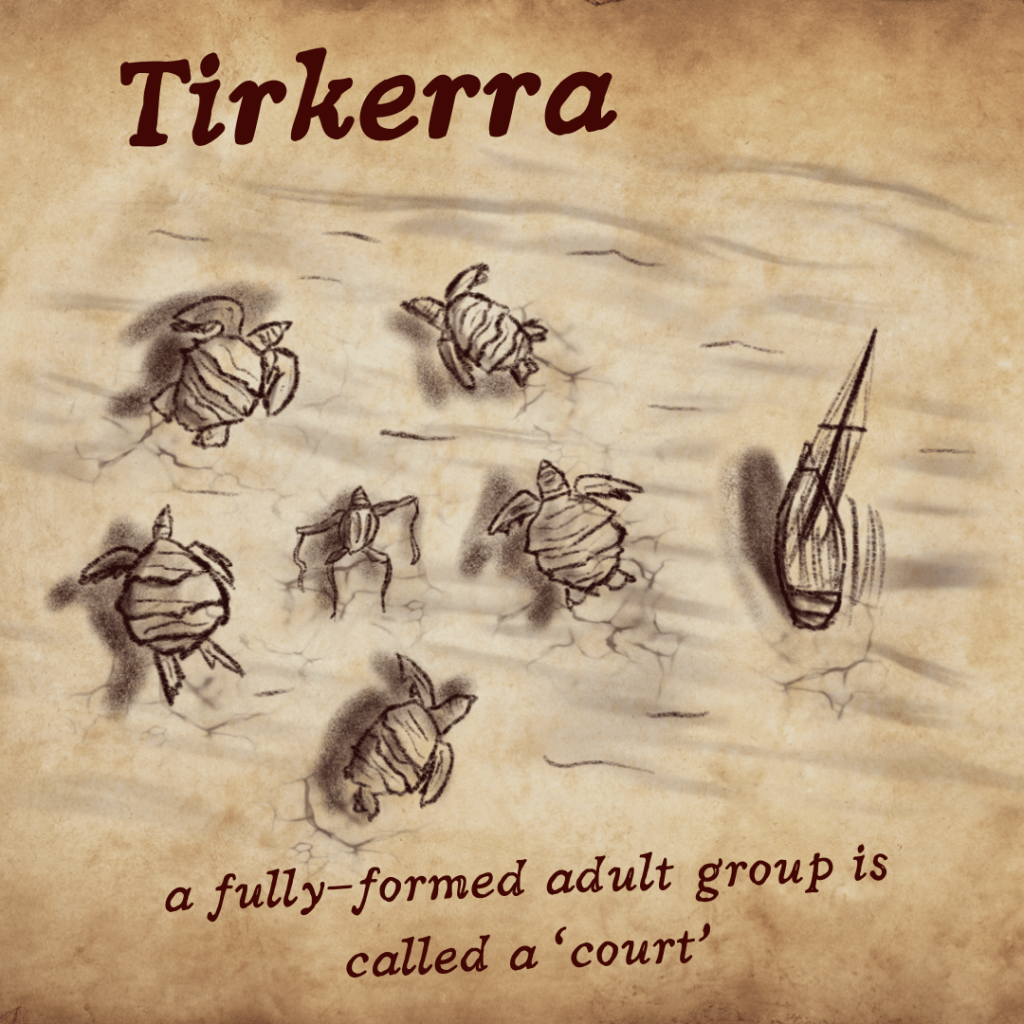
Relga sailed back to the shore to Harland, who had waited patiently for her return while watching a court of tirkerra drift around nearby. She shared her revelation with him, and together they went back home—only to find the hut in flames. The Raven was nowhere to be found. As Relga surveyed the wreckage, three assassins leapt out of the shadows. One of their blades was aimed at Relga—but instead it found Harland, when the Kerraguard-Captain pushed her out of the way.
His sacrifice bought Relga a chance to collect herself and strike out. Back to back with Harland, they battled the assassins, striking them down one by one until it was just them two standing—and then just Relga, when Harland toppled over. Relga rushed to his side, frantically trying to save him, but the old captain smiled a bloody smile and said all was well.
At long last, he had done his duty. His final words.
Relga reeled from the death of Harland, but when she looked up from his body, and saw the charred swamp the assassins had set aflame, something finally sent her over the edge. Not only had the Bear and the Doe’s assassins taken her only father figure in life, they had taken her beloved home. The willows, the reeds, all that swam and crawled amongst the riverlands. If left unchecked, the Bear and Doe would see all Rivona reduced to this.
Now Relga had her reason for going to war. Now Relga knew what she wanted. And now, she had a weapon to smash the Vengeful Marriage to pieces.
Subscribe to get access to the rest of this post and other subscriber-only content.

Jayne had been right. I was a little doe, and had unwittingly drawn in the wolves.
The evening, I confronted Dallyn in the barracks, after he had locked up Jayne in a cell overnight. The first thing out of his mouth was an apology. He found deception and trickery distasteful. Not distasteful enough, I pointed out sourly. Dallyn laughed—a booming, boisterous noise that was beginning to get beneath my skin—and demanded what better recourse I could offer. Did I wish to set the bird, unpunished, free into the sky? A folly. Nothing would change. No matter what I wanted to believe, Jayne was a person—capable of harm, lawbreaking, and evil, just like the rest of us.
And yet, what would Dallyn do about it all? Nothing. Even though the local lord had granted him leave to settle this however he wished, Dallyn would let the townsfolk—the victims—do the honors. At dawn, they’d tie Jayne up and dangle her off the side of the town’s namesake bridge. For one day and one night she’d suspend over the water, facing the judgment of the rivers and ravens. If she survived, she’d be reeled up and set free—something that had never happened in the town’s history.
I gawped at Dallyn. Some parts of Rivona, it seemed, had yet to change from the brutal days of Rugon the Ruthless. Was this what had happened to the town’s previous riverbird? Dallyn glanced away. It hadn’t been him who had levied that sentence, but the Guard Captain before. This was how Angler’s Arch dealt with rogue riverbirds in hopes of keeping them away, he explained. It wasn’t law, but it was tradition.
I tried to protest, but Dallyn cut me off, pointing into the record room behind me. After nearly a week’s work, I had transformed it from a paper hell into a small archival oasis that would make my old friend proud. Upon one of the desks was a stack of papers—I had been reading the story of Kerraguard-Captain Harland, Dallyn observed. Good. He reached into his desk and pulled out an old, battered tome: Kerraguard Exemplar. He’d been wondering where those loose pages went. As my final task—and before I argued any further—he told me to fit those loose pages back in and then finish the story of Harland, the Somber King, and Bloodhawk.
I spent the evening doing just this—and did not get much sleep.
Harland and the White Crow combined forces to stop whatever sinister plans Dessiri had for the king. They lacked evidence—without which the king would fail to see reason, too enraptured by her charms—but they planned to change that. Harland couldn’t play games of shadows, but he was no fool. Sifting through his observations over many months with the White Crow, a gap emerged in Dessiri’s story: where was her river hut? They’d never passed by it in river walks, and the riverbird rarely spoke of it. The White Crow shrugged, saying that Dessiri didn’t have a hut—agents had followed the riverbird home to a meager camp a few times.
Harland refused to let go of this fact. Unlike the White Crow, he had grown up in Angler’s Arch and knew the ways of riverbirds. Namely, that each one had a hut. Where was Dessiri’s? And why was she hiding it? This convinced the White Crow. She and her agents went out to sweep the river and surrounding country while Harland kept vigil over the king. After several days of thorough searching, the Crow found Dessiri’s hut, little more than a neglected pile of sticks tucked away in the back of a marsh. More importantly, they found a foreigner, a Khorven man, hiding out there.
The full moon was out, bathing the clear night in a shade of cold silver, when the Crow brought the Khorven man back to the castle. Hearing the news, Harland rushed to the dungeon. Together, with the Crow, they tried to pry information about of him, but he wouldn’t talk. Not until Harland offered him a clean death with his sword, as opposed to the Crow’s preferred way of dealing with people: turning them into ravenfood. At this, the man finally gave in. He had been waiting for Dessiri—to escape Rivona after her mission was complete.
What mission, the Crow demanded? But Harland sprinted from the dungeon, pounding up through the castle to the royal quarters. The hall outside smelled faintly of moss, turned earth, and blood. The two Kerraguard standing sentinel had collapsed against the wall, their throats slit. Then someone screamed from the children’s room. A moment later came the wailing of infant babies. The three royal children. Harland shoved through the door—and what he saw next would stay with him for the rest of his life.
The Queen lay lifeless on the floor, blood bubbling from the gash in her neck. Dessiri stood by the window, flung open into empty air. Her frazzled hair stuck to the blood on her shoulders, arms, and hands. One child screamed from its crib. One. With a nauseating turn of his stomach, Harland realized the other two cribs were empty. When he looked back to Dessiri at the window, a primal rage boiled up from within him. Sword drawn, he lunged at the riverbird, but was too slow. She darted for the window, intending to climb out and scale down the side of the tower.
But as Dessiri started to climb out, an arrow struck her in her breast. She stumbled back into the room, falling at Harland’s feet. She looked at him, opened her mouth to say something, but never got the chance. In one great double-handed swing, the Kerraguard-Captain beheaded her.
Heaving breaths, Harland staggered to the window and spotted the lucky archer: the White Crow, perched atop of a nearby tower. He nodded to her. She nodded back, and disappeared into the tower. At that moment, Rogar finally burst into the room, drawn by the commotion. When his eyes fell upon the body of Dessiri, he let out a horrendous shriek and collapsed over her. Harland, barely able to speak himself, tried to explain what Dessiri had done, but Rogar heard none of it, sobbing over the body of the riverbird. All was lost, he declared, beholding the bloody scene around them.
No! All was not lost. One child yet lived. Harland hurried over to the crib and was relieved to see the babe was unharmed. He turned to share the good news with the king—and his blood turned to ice. Rogar had climbed up onto the windowsill. Without another word, without even looking back at the Kerraguard-Captain, the king stepped out into open air and plummeted into the night.
So ended the life of the Somber King.
Not succumbing to wounds after fighting off an assassin, as some songs claim. Not from the traitorous talons of Dessiri, as his grave declares. No—according to Kerraguard Exemplar, it was by his own hand. That blood-soaked tower would soon become known as the Talon, the events within known as the Bloodswoop. And Rivona would never be the same.
With all this and more on my mind, I rose to face the morning—the day that Jayne was set to be sentenced. I found Dallyn before he went out into the town and told him I’d read about the Bloodswoop, that I understood a little better now. But—and this was a very important but—I had one question: did he wish for things to change? For Angler’s Arch to be free of rogue riverbirds? If he did, then it had to start with him. He couldn’t treat Jayne as a rogue riverbird, not with all the curdled history and cycles of revenge behind that word. She was a person, wasn’t she? Treat her as that instead.
Then I handed him back Kerraguard Exemplar. I had read enough.
Dallyn glanced down at the book, then back at me. Something changed on his face. He did not speak again until he stood before the townsfolk gathered just outside the barracks. Half of Angler’s Arch had showed up, eager for Dallyn to release Jayne from her cell and into the hands of the mob. I lingered at the edge of the crowd, rattling like a leaf, unsure if I could watch what would unfold.
Dallyn raised a hand to quiet the crowd. Then he announced that, according to the laws of Angler’s Arch, Jayne would return all that she had stolen. Then she would be chained up and sent to the dungeons of Great Forks, where she would remain for five years—as could be expected for anyone with her roster of crimes. Let it be known, Dallyn said, that Angler’s Arch dealt with criminals justly and fairly.
There was an uproar, of course. Some people were quite passionate about their bloody traditions. But Dallyn would hear none of it, telling them to complain to the local lord instead. And while he controlled the situation and dispersed the crowd, things were far from over—as he explained later, when he found me in the barracks. Things would probably get worse with the townsfolk before it got better—but at least that was a straight path forward, rather than circular. It would be some time before Jayne was sent off, and he intended to ask her a few questions.
Still a bit jittery from the sentencing, I thanked him. He waved it aside, saying I had earned myself his gratitude, a week’s pay, and unofficial exile from Angler’s Arch. The townsfolk would soon suspect I’d had a hand in Jayne’s sentence (if they didn’t already). The sooner I left, the better, and I couldn’t help but agree. As I turned to pack my things, he handed me back Kerraguard Exemplar.
Go and keep reading, he told me. The story didn’t end with the Bloodswoop.
In the world of tirkerras, few things are as traumatic as the death of a tirkerra queen. Her male knights will deal with the loss in different ways. Some will defend her body, refusing all sustenance until they, too, succumb with her. Others will roam the open lake, searching for a losing fight, even throwing themselves at creatures five times their size. Several swim down into the deep darkness, never to return to sunlit waters.
Doubtless such thoughts crossed Harland’s mind as he beheld the bloodbath around him. He had failed in every way imaginable. Kerraguard were supposed to die before their king. Not the other way around. In Harland’s mind, the only acceptable alternative—the only just reward, the only suitable punishment—was to follow his king into death. He stepped up onto the windowsill of the tower.
Wait! The White Crow cried out as she rushed into the room, pleading him to stand down. Harland shook his head. Why should he? After this massacre? The White Crow glanced around, silent, her expression hidden in the darkness of her hood. She edged closer to him, her hands up. Because, she said, the Somber King had needed something that a White Crow or Kerraguard-Captain could not give him.
The cool night air brushed over Harland, still on the windowsill. It didn’t matter, he said. From the king to fellow soldiers to his wife and child, he had failed to protect people he cared about all his life. Let someone else take his place and do a better job than him.
The White Crow was almost within arm’s reach. Pain, suffering, and regret are life’s constant companions, she said, and too easy do they convince a person they are their entire world. Think instead, she urged Harland, of all the people he had saved. Think instead of how he rose from tragedy to become one of Rivona’s finest swordsmen. Think instead of what good he can still do. Think of the tirkerra knights that, after their queen perishes, swim on to find another one to protect. The White Crow pulled down her hood, gently placed a hand on Harland’s arm.
“The line need not end here.”
What Harland saw on the White Crow’s face, we do not know—quite literally, for I do not have any descriptions of the woman. Whatever it was, it finally convinced him to step down from the windowsill. Even if, for many reasons, he could not be Kerraguard-Captain anymore. That was fine, the White Crow said. Their duty was to Rivona now—and it would start with the only survivor of the Bloodswoop.
Harland and the White Crow approached the crib. Within was a little girl who had cried herself back to sleep, untouched by tragedy. Her name was Relga Craythe. And with the help of the two people standing over her in that tower, she would rise to become one of the greatest women in Rivonan history, changing the world forever and earning herself a name and title still spoken with reverence to this day.
Reclaimer.
Bloodhawk.
The riverbird would not be known by that title until later. When Rogar stumbled across her while walking along the river, just outside the walls of Great Forks, she introduced herself as Dessiri. Green-eyed, freckled, and frazzled of red hair, appearing from within a copse of willows. Harland, who had been following the king at a safe but respectful distance, rushed forward to intercept Dessiri—but was too late. Rogar waved away Harland, already enchanted by the riverbird’s beauty.
Harland distrusted Dessiri the moment he laid eyes on her. He tried to tell the king as such, but his warnings could not compete with Dessiri’s singsong voice. Each day, Rogar went out to see the riverbird, like a sailor ensorcelled by a siren. Over many months, the two grew closer. River walks became strolls in the castle gardens. Those strolls became intimate tours of royal quarters. Eventually, Dessiri ended up in the king’s bed.
Was some dark, seductive magic at play here? Or was Dessiri providing something that the king had been starved of his whole life? Nobody can say for sure, but it’s worth noting that Rogar was married with three children. For this reason and many others, Harland protested—carefully, but firmly— every step of the way, at every talon Dessiri closed around Rogar. And yet, all this earned him was the growing enmity of his king. Why, Rogar demanded, was Harland so against the happiness he had found in Dessiri? His kingdom was dying, his marriage was loveless, and his infant children possessed a bleak future.
Dessiri, the king declared, was his only light in life.
The riverbird tormenting Angler’s Arch was no Bloodhawk, but the townsfolk were already calling her names. Thief. Fraud. Birdshit. Whore. And, of course, witch. I overheard all of this and more, wandering the docks and market stalls during breaks from my work. As I dangled my feet off the town’s namesake bridge, watching the painted salmon swim below, I eavesdropped on conversation from passerby. Most everyone gossiped about Jayne’s latest crime, and what they wanted to do when she was finally caught. Palpable anger soaked their words and expressions, and it was getting more intense with each passing day.
I couldn’t help but think back to my time with Arlisse. How her neighbors—peaceful, welcoming, and caring townsfolk—had thronged together to form a vicious mob. All in defense of her, of course, but the transformation had frightened the everloving hells out of me. If those kind people were capable that, what would the people of Angler’s Arch do to Jayne? I didn’t want to find out. The night before my last day of work in the barracks, I struck out into the riverlands in search of the rogue riverbird. I had a few ideas of where to check.
Harland, unfortunately, was not so lucky. Consider his role: Kerraguard. That name—and much of the order’s code and training—was inspired by the tirkerra, a turtle native to the vast, open waters of Lake Liron. Growing to the size of fishing boats, tirkerra live in groups of five males fiercely protective of a single female. The tirkerra queen dictates where the group roams, sleeps, and feeds—but she herself is fragile thing, lacking the thick shell, beak, and barbed fins of the males. At all times, her ‘knights’ protect her and her young, employing defensive formations when attacked by grotters, nissadons, and other deeplake predators. In a crisis, a male tirkerra will sacrifice itself so that the queen and her group can escape—a display of courage and honor by any definition.
Every Kerraguard in training has this way of thinking drilled into their heads, and Harland was no exception. In addition to advanced combat training, he learned to navigate the perils of the river—how to swim, rescue a drowning person, and sail a riverboat. (Sadly, his training did not teach him how to fish). He emerged as one of Rivona’s finest swordsmen, and though he eventually rose in rank to Kerraguard-Captain, his duty and loyalty to Rogar remained steadfast.
And yet, for all this training, he was out of his depth with Dessiri. He believed she was not good for Rogar—at best, an opportunistic charlatan preying on the king’s vulnerabilities; at worst, a foul actor with sinister intents. He couldn’t shake the feeling it was the latter—not with the way she sought ‘privacy’ with the king, studied the layout of the castle, and met Harland’s gaze with a sharp scowl. And yet, she had done nothing except shower the king in love and affection. Harland could gather no evidence for anything otherwise, so his attempts to send her away or bar her from the castle were thwarted and overruled by Rogar.
Harland’s training as Kerraguard could not help him in whatever game Dessiri was playing. With nowhere else to turn, Harland sought the aid of the White Crow, the king’s spymaster. An ally—but one who operated from the other side of the coin. What little Harland knew of her shadowy work, he disapproved of, but it was not his place to question. Since Dessiri had come into the fold, he had been keeping in light contact with the White Crow out of strict necessity, but now he brought all his concerns front and center.
For perhaps the first time in history, the Kerraguard-Captain and White Crow agreed. One way or another, they were going to nail the riverbird to the wall.
I, too, sought a reluctant alliance—or at least a common understanding with Jayne. Using lessons I learned from Arlisse, I picked my way through the wilds outside of Angler’s Arch. As the sun was setting, I came across an abandoned hut. The home of the previous riverbird. Dallyn had told me Jayne didn’t live there—they had searched it, many times. What he hadn’t told me was that the hut was little more than half a pile of sticks that had been burned to the ground.
What had happened here? I soon got my answer. I pressed onwards into the wilds, searching for secret riverbird signs I had been taught to look for—gentle marks in willow trunks, wreaths of water poppies hung from branches, riverstones piled together. They weren’t as expertly constructed or hidden as Arlisse’s, but they led me to Jayne all the same.
When she leapt down from a willow tree, fishing spear pointed at me, I held up my hands and proclaimed I was here in peace. That I only wished to talk. The riverbird cackled at me. Talk? What was there to talk about? The people of Angler’s Arch, she explained, were ignorant, greedy, and violent, and deserved everything that happened to them. I pleaded for her to stop her attacks, otherwise she would end up lynched like countless riverbirds before her.
“Did you not see the burned hut on the way out here, little doe?”
Such was her response. But before I could remark to that, Jayne jumped and let out a shriek. A dozen guards burst out of the trees, surrounding us. And at their head—guess who? None other than Dallyn.
I couldn’t speak past the shock and anger clogging my throat. Before I knew it, the guards had captured Jayne, bound her in chains, gagged her. Dallyn placed a hand on my shoulder, telling me I had done the town of Angler’s Arch a great service. A service! A service? I wanted to slap him. Instead, I demanded to know what he was going to do with Jayne.
He invited me to see for myself. Her sentencing would be at first light.
Not all riverbirds were good.
Or at least, this was what Dallyn and the townsfolk of Angler’s Arch believed. After living with Arlisse and learning the story of the Riverbird Traitor, I struggled to adopt this view. It was hard to picture riverbirds as anything other than caretakers of the waterways; a force of benevolence that made Rivona cleaner and safer. So how had bad blood festered between the town and its local riverbird, Jayne?
At first, I thought it was a classic case of misplaced suspicion. Falsely accusing a riverbird of witchcraft was practically a Rivonan tradition, after all. Arlisse had warned me as such, telling me that distrust in riverbirds tended to increase the closer a town was to Great Forks. Even if you take out superstition, most city-dwellers didn’t understand a riverbird’s connection to the wilderness, often feeling they got in the way of trade and fishing. And Angler’s Arch was a hop and skip away from the city.
Yet the trouble with Jayne seemed more than repeating history. Over the next several days, over the period I worked in the guard barracks beneath Dallyn, Jayne struck back against the town, most of the time at night. She raided a store of its herbs, opened the horse stalls, and even stole someone’s cat, sneaking in and out before the guards could find or catch her. The riverbird, it seemed, was earning her fair share of collective anger and hatred.
Some of that reflected onto the new woman in town. Me. With my history with Arlisse, Dallyn distrusted me, which meant every guard beneath him did, too. I slept on a cot in a room with three other women, neither of which uttered a single word in my direction. Nobody sat next to me in the mess. In hallways, guards gave me wide berth, as if I carried a case of Everscratches. Arguing or challenging any of this, I figured, would only cast more suspicion onto myself.
Not to worry. The story of Kerraguard-Captain Harland and the Somber King kept me busy. As I continued to sift through the chaos of the record room, I found more loose papers on the events that unfolded—and on Harland himself.
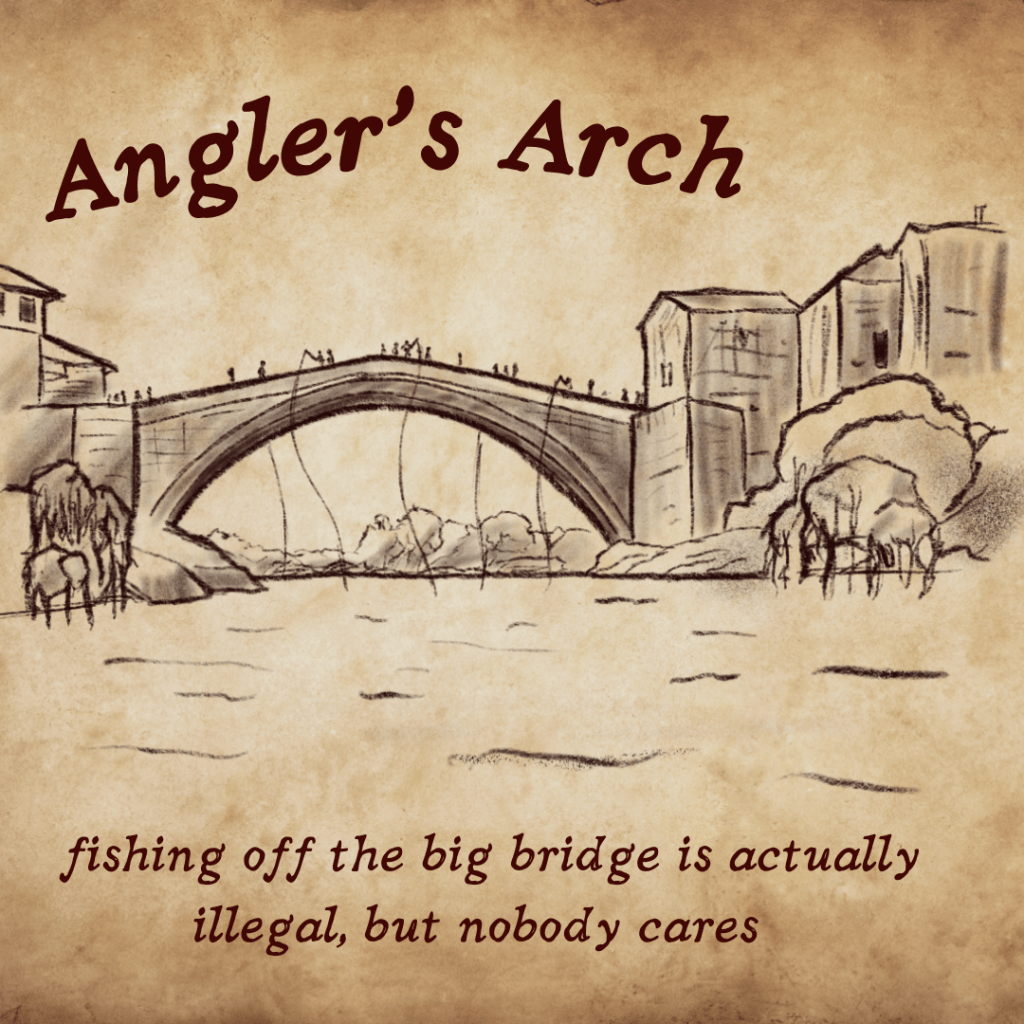
Harland and I shared a trait: we were both terrible fishers. As a young man, Harland struggled to snag even a single painted salmon from the bridge that was the namesake of Angler’s Arch—a bridge famous for its easy fishing. He did, however, hook the attention of a young woman, who fell in love with him despite his lack of skill.
Determined to start a family with her, Harland found a job as a dockhand, hauling cargo and catch to and from river boats. Before long, he married and started a small farm with his wife on the outskirts of town. They enjoyed several good years together, but it was not to last. Complications with birth claimed the lives of both his wife and newborn son.
As the Rivonans say, the Raven roosted in his home. After such a tragedy, many search for solace in their cups, gambling, or other vices. Harland, however, walked it off—but not in the way you’re thinking. Unable to live in a home cursed by such grief, he abandoned the farm and returned to dock work. At the end of each and every day, he walked along the river until late at night. Townsfolk and river crew often found him sleeping amongst boulders in the morning. For years he lived in this way, seeking nothing save a meager living and his daily walk along the riverbank.
Only one thing shook him from his trance. When the queen and her firstborn son were assassinated in 906 ASF, Harland answered the call to war. To understand why, we only need to look at his record. The king’s war of vengeance turned many into butchers and animals, but not Harland. In any skirmish or battle, his priority was to save his fellow countrymen and soldiers—a trait he lived to a fault. During the Battle of Hawkfalls in 907 ASF, Harland ignored orders to capture an enemy officer, instead rescuing several hostages from a burning tower. He saved their lives, yes, but the officer got away.
In many respects, Harland was a terrible soldier—but he had the makings of a Kerraguard. After Hawkfalls, the Kerraguard-Captain took note and invited Harland into the fold. His duty would not be to slay enemies or capture fortresses, but to—above all else—protect the royal family. After a year of arduous training, Harland was inducted into the order and assigned to Rogar Craythe, the second born son who would become the Somber King. At the time, the boy was only eight years old.
This meant that, over the years, Harland personally saw the boy wither from neglect, guilt, and the weight of a crumbling kingdom that would soon fall upon his shoulders. Harland did all he could: training with the boy each day, sharing meals with him, lending an ear to his complaints and woes. This was no substitute for the love and bond of the boy’s father, who was too preoccupied with grief and vengeance. But Harland dare not overstep that boundary. His duty was to protect Rogar, not to be a father to him. Even if he may have wanted to.
Just as well, my duty was to organize Dallyn’s record room and keep my mouth shut. But after several days of being shunned by the entire barracks (even the resident black cat ignored me, but that might have just been a cat being a cat), I confronted Dallyn. One evening, when he came to check on me, I asked for an explanation. Not for why I was shunned, but for the situation with Jayne. As for why I wanted to know: maybe I could talk to her, convince her to stop her attacks.
Dallyn laughed dry, invited me to be his guest, and indulged me. Several months ago, he said, Jayne had shown up in town and introduced herself as the new local riverbird. She’d demanded food, herbs, and supplies to set up her new river hut upstream. Nobody had donated—for Angler’s Arch did not want or need a riverbird. Frustrated, Jayne had left, then returned a few days later, demanding alms, only to be denied again. The third time Jayne came back to town, she carried a threat—that without her, the river would surely muck up and become a graveyard for fish.
To this, the townsfolk had told her to go upstream or get lost. Jayne’s attacks had started shortly afterwards.
Now that Jayne had established herself as a criminal, the local lord had tasked Dallyn with capturing her and bringing her to justice. When I heard that, a chill ran down my spine. What did that mean? We would just have to see, Dallyn replied, but if I could talk her down, then by all means. He wouldn’t be holding his breath, though.
“Not all riverbirds were as good as you want them to be, Elandra.”
I was undaunted. Perhaps there was something more I could do in Angler’s Arch than sift through old paper.
Harland must have felt similar, when the boy he vowed to safeguard transformed into a man who “accidentally” fell into the river. Harland wanted to do more than just act a bodyguard—he had to, if he wished to protect the Somber King from himself.
For the first time in his long years of service—and his entire life—Harland played the part of a father. Instead of merely listening, Harland offered his opinion, his advice, even plans of action. Rogar dismissed these, claiming that every path before him was doomed. Harland switched instead to questions that probed at the king’s mind and heart, but this only made Rogar clam up. With growing frustration and desperation, Harland urged the king to seek out joy in an interest or passion—fishing, hunting, or falconry, for example—to balance out the dark news that plagued his court, day by day. Rogar refused—what point was there in seeking happiness, when it was only a matter of time before the wolves closed in?
Nothing worked. Harland did not have experience as a father, after all. Or perhaps he pushed to king too hard. At his wit’s end, Harland made one last exasperated suggestion: to walk the river each day, to listen its sounds, to feel its cool water—as Harland had, after losing his own family. Hearing this, seeing his Kerraguard so distressed, Rogar finally listened.
You might think this was a turning point. It was. Just not in a positive way. For it was along the river, during these walks prescribed by Harland, that Rogar met a riverbird.
And, according to the loose pages I had scavenged, she would come to be known as Bloodhawk.
Not, I presumed, a good riverbird.
Why, as humans, do we place so much attention and importance on the negative?
Can you recall each and every time someone has told you “I love you”? Perhaps. Perhaps not. But I would wager you recall the “I hate you”s much more clearly—and that they will stay with you far longer.
History, too, has this bias. Nobody writes a thousand-pager on the years with decent-but-not-excellent crop yield, the continual improvements of bridge building over time, or the reign of a peaceful and generous king. (Although, as we learned in the last volume, even “Righteous” kings are not immune to scandal!). No—instead, we remember the bloody wars, the blackest of betrayals, the widespread tragedies. History is supposedly all about bringing light to the past, yet it seems to be obsessed with its darkness.
I am guilty of this myself, for this Volume covers one of the darkest periods in all of Rivonan history: the tragedy of the Somber King.
Let me paint you the picture. Rogar Craythe was born in 901 ASF as a second son to Roland the Righteous (technically a third son, if you count the firstborn son that Roland gave to the river. It might have been tradition, but I imagine it didn’t help the mental state of surviving children.) When Rogar was five, his older brother and mother were slain by foreign assassins, and his father spiraled into vengeance. A twenty-year-long, all-consuming war of vengeance that robbed Rogar of his childhood and cast him into his dead brother’s shadow.
And to what end? His father perished in battle, leaving his kingdom, splintered and weakened and surrounded by enemies, to Rogar. By this point, over two decades had passed since the assassination. Two decades of stewing in neglect, guilt, and fear. In many ways, Rogar was the Somber King even before he put on the crown.
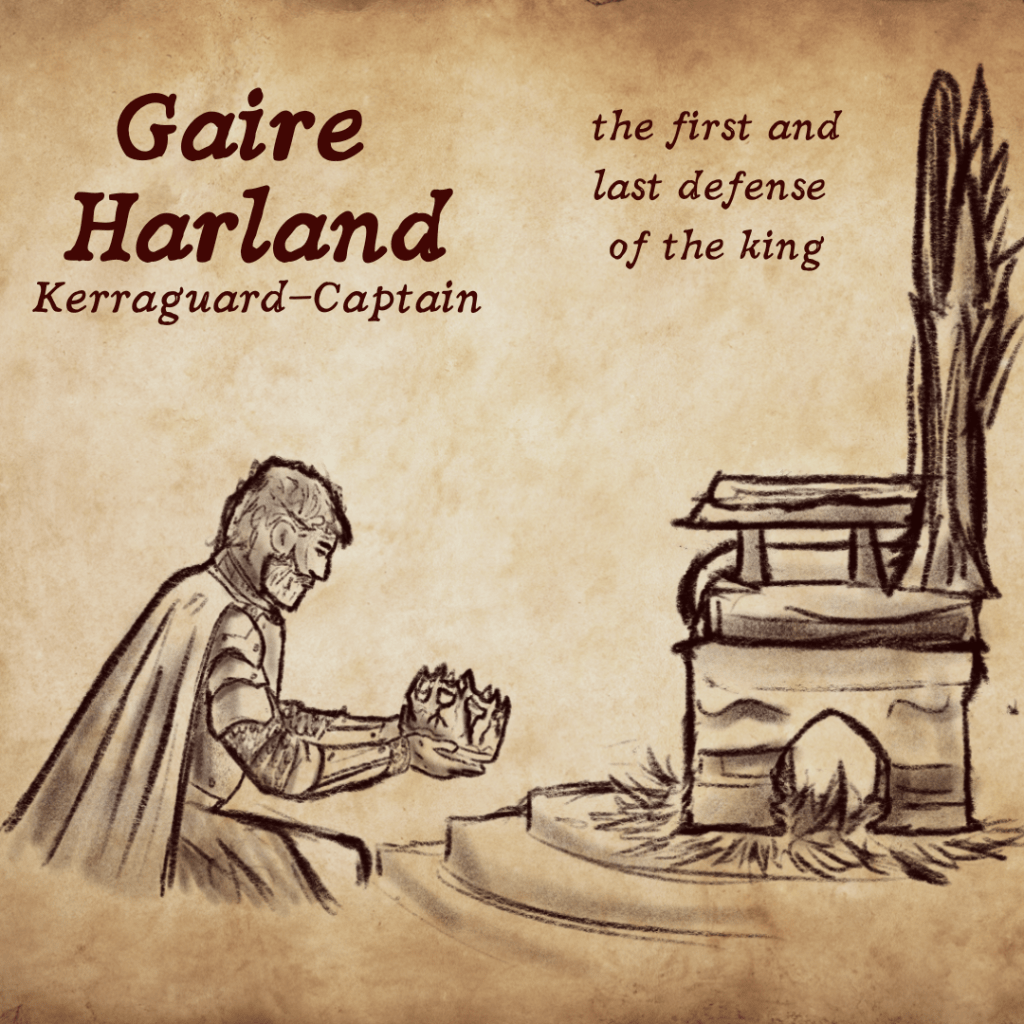
This, however, is not Rogar’s story. It is instead the story of his personal guard, Kerraguard-Captain Harland, who played a bigger role in history than the king himself.
Why Harland, you might ask? I asked myself a similar question as I arrived into the town of Angler’s Arch. Dominating its central fish market was a ten-foot stone statue of a man—armed, armored, and kneeling, his sword at his side, his steely gaze distant—as if swearing fealty to the riverlands itself. As I soon discovered from the plaque, this was Kerraguard-Captain Harland, who was born 879 ASF as a fisher’s son in Angler’s Arch. How had Harland earned such a pedestal, one that rivaled those of kings and queens?
There was no way to know—the rest of the plaque was unreadable. Someone had defaced the rest of the engraving with a black, tar-like substance.
Intrigued as I was, I did not have time to solve this mystery. After my botched attempt at riverbird life, I needed to find another way to feed, clothe, and shelter myself. Arlisse had brought me to the outskirts of Angler’s Arch, but no further—the town wasn’t known for its kindness to riverbirds. Spending the night beneath one of its bridges seemed an equally unkind experience, so I set about finding work about the town.
I couldn’t fish worth a damn—my mother would be ashamed!—but I could read, write, and perform a few clerical magic tricks that dazzle people too busy for paperwork. I sought an audience with the local lord, but was refused on account of my nobodiness (you would’ve thought the name Karpe might have carried some weight in a fishing town. Alas.) I offered to count figures in a merchant’s house—they had plenty of numbers, but none to spare for me. I found luck at last in the guard barracks, where I happened to catch the Guard Captain at his desk, drowning in a mound of papers.
His name was Dallyn. Tall, rugged, dark of hair, beard and expression; a big bear of a man trapped by the iron teeth of bureaucracy. Needless to say, my bid to alleviate his administrative woes seemed to be music to his ears. I even flashed my University seal as a show of credentials (although I conveniently left out I had been expelled). Impressed, Dallyn proposed a trial period of a week to organize his mountain of records and letters. In compensation, I’d receive a place to sleep in the barracks, meals in the mess, and a small amount of coin.
And I could get started. Today. With the record room. When I peered inside, my skin crawled. Shelves upon shelves of coated in dust, packed full of books wedged in at every orientation. Scrolls and letters had been stuffed wherever they could fit. Spiderwebs in the corners. Splotches of dried ink spilled ages ago. Candlewax caked onto the desk.
It was a place of bookkeeping insanity.
None of it was particularly private or valuable, Dallyn said, which is why three Guard Captains before him had ignored it. I could organize the chaos however I saw fit, and to call if I had any questions. But, Dallyn added, he really preferred if I did not. My progress and quality would be assessed by how well he could see the floor.
And I had thought Lorekeeper Chrasse was disorganized! Still, it was nothing I hadn’t seen at the University. Employing a technique learned from an old friend, I began by sorting things into categories—books, letters, and scrolls, for example—and then those further into subcategory topics, such as financial records and complaints from townsfolk (two hefty topics!). Dallyn was right—most of things were dreary and nap-inducing, but here and there I unearthed delectable tidbits of knowledge. Sappy love letters (how had they ended up here?). An obituary for amateur corvil hunters. Wanted posters of a serial arsonist who exclusively targeted windmills.
Gossip aside, I discovered a loose sheaf of paper that looked like it belonged to something more respectable. A history book or collection of research, perhaps. Tempted, I scanned it over, only to find it spoke of Kerraguard-Captain Harland and his vigil over Rogar, the Somber King. Perhaps I could fill out some of the knowledge I’d missed on that defaced plaque. Not all, though. The page seemed to have fallen out of the middle of a book, with none of its like nearby. I would have to be satisfied with this piece for now.
I wasn’t.
The page described the time around Rogar’s ascension and inheritance of a kingdom on the brink of ruin in 930 ASF. If you think that appointment is difficult, consider the duty of Kerraguard-Captain Harland. He was sworn to protect the king from all harm, from assassins in the night to opportunists within the court—a difficult enough task in peaceful times. Still, Harland rose to the challenge. He personally vetted the entire castle staff, instituted shifting patrol schedules, and ensured four loyal eyes watched the king at all times.
For all his valiant efforts, he could not thwart all danger. While crossing a bridge one day, Rogar slipped and toppled over its edge, plummeting into the river below. Right in front of Harland, too. The Kerraguard-Captain leapt into the water after him—an act that almost drowned them both, on account of his heavy armor—but the rescue was successful. News and rumors soon spread throughout the court. Had this been an assassination? Had someone pushed the king? Had someone slicked the surface of the bridge?
Harland was not so sure. None of this speculation aligned with what he’d seen with his own eyes. The king had fallen entirely of his own accord…but had it really been an accident? If not, then his duty had just become tenfold more difficult. Kerraguard training had not prepared him to protect the king from himself.
I could empathize—at least on a (much) smaller scale. My task, soon, became much more prickly, and not because of the nest of cockroaches I found behind a bookshelf. When Dallyn came back to check on me, he approved of what I’d accomplished thus far, and asked me how I’d ended up in Angler’s Arch. I mistakenly answered with the truth: that I’d tried to live with a riverbird. At this remark, all friendliness in Dallyn’s face drained away. Jayne, he demanded—was I friend of Jayne? I blinked. Who? I explained I’d been with Arlisse, one town over.
This did not reclaim the trust I had lost, though. Jayne was the unofficial riverbird of Angler’s Arch. Unofficial because the town had never “adopted” her. In fact, they hated her. For months she had been sneaking into town, stealing from stalls, releasing livestock from their pens, and causing mischief nobody found amusing, least of all Dallyn. Jayne’s latest work was the vandalism of Harland’s statue.
Dallyn wanted nothing more to do with me, but upheld his word. I could work the week, as we previously agreed. But only as long as I kept my head down, my nose out of trouble, and any thoughts about riverbirds to myself.
I promised. I needed the job, after all. And I tried. I really did. But, as you can probably surmise from the existence of this volume, I failed.
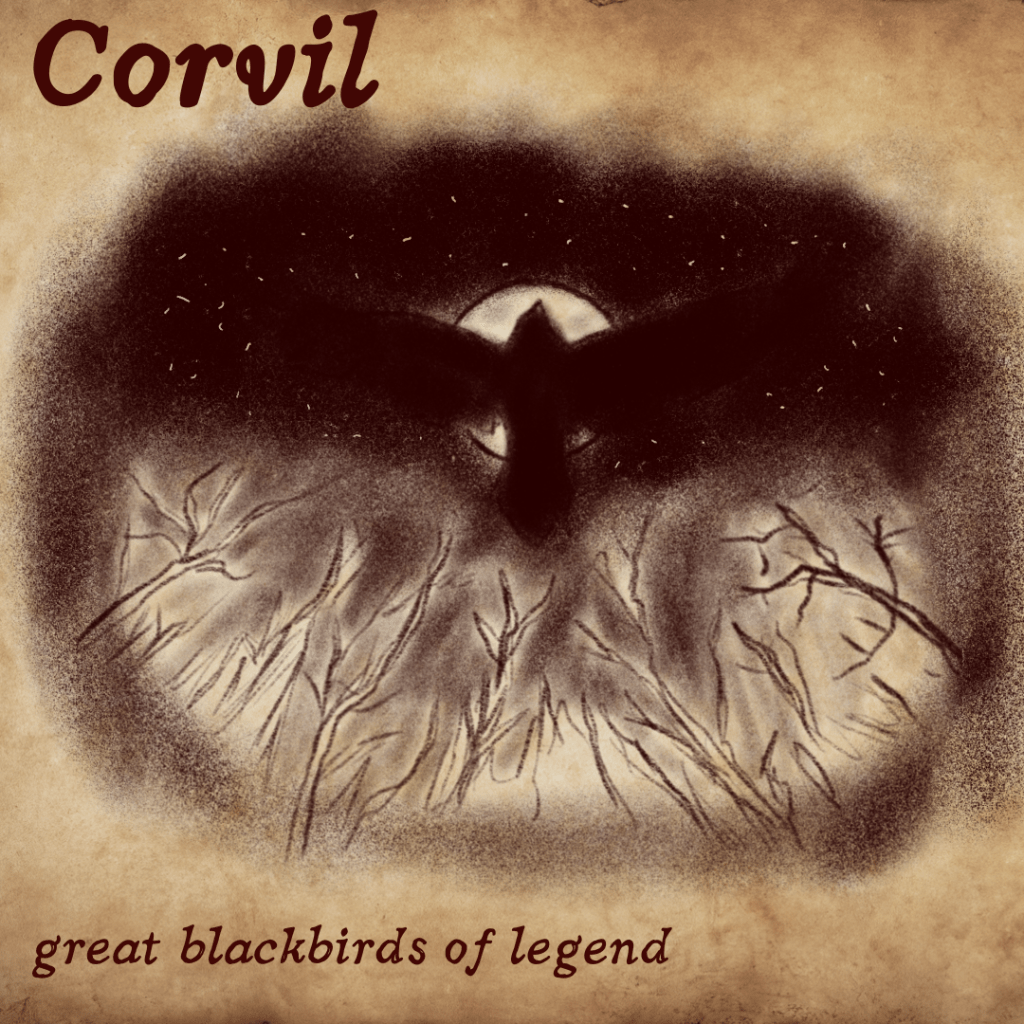
One breath. This was all I possessed before the dusty man from the crossroads captured me. I used this to scramble up and boot the cauldron with my foot. It stung. It burned. But it did what I wanted: send sparks flying and embers rolling everywhere. Small flames caught on dry grass and leaves and began to spread.
This didn’t stop the dusty man from cracking his fist against my jaw, and I crumpled like a wet scroll. The next thing I knew, I was tied against a tree with Arlisse. Both our mouths had been gagged. The men, I saw, were trying to put out the flames. It had now spread everywhere, from the herb-drying rack to the chest of tools, smoke trailing into the sky. When the flames licked up the river hut, the men abandoned any attempt of control and turned towards us.
The dusty man was one step from me when an arrow skewered him in the chest.
More arrows whistled out the trees, striking the men in the knee and gut and throat. Then a group of people came charging onto the scene. The townsfolk, I recognized, the baker and the blacksmith and the weaver and many more, drawn by the plumes of smoke curling into the sky. I flinched as they cut down the men with a maddened and primal savagery only mobs can possess.
They unbound us, brought us away from the burning river hut. Arlisse didn’t even watch her home go up in flames. She put my face in her hands and held me tight, asking if I was alright. I tried to apologize, but she shushed me, praising me instead for my quick thinking. Her nest was of the riverlands. She would rebuild it.
The only thing in question is whether or not I would help her. And to decide that, she said, I needed to hear how a story ended. We went to town with the baker, who opened his home to us without question. When we had recovered and settled in, she finished her tale of the Riverbird Traitor.
We rejoined Sarsha as she scrambled across the Rivonan wilds, fleeing from the assassin that had murdered the old crone.
Sarsha dared not return to her village, or anywhere another innocent could be hurt. She soldiered on through the wilds, using all she’d learned to find her way. Spaces between willows and nettles. Dry ground across hazy mires. Hidden shallows in the rivers. Normally this pathfinding meant she travelled far swifter than most—but not the assassin. They kept up. How? And how had they surprised her and the old crone?
Sarsha soon guessed the truth. There was knowledge in the assassin’s path, an experienced ease in their movements across the land. Then Sarsha spotted the face of a woman beneath the assassin’s cloak, and she knew. And when she was certain, she crossed a river and dislodged the natural bridge of sticks and trunks behind her, so that the assassin could not follow. Then, turning to gaze at the opposite riverbank, she called out to her hunter.
“Stop! We are flock!”
The assassin laughed, a cold and shrill sound. Maybe once, she said, but not now, so it was better to come willingly. Why cling to the rivers and ravens, anyway? They did not protect riverbirds from slander, from suspicion, from the pointing finger. Nor did the realm, which benefitted most but offered no thanks in return. The assassin grinned. Love it or hate it, but life was simply better within the circle of the King.
The circle of the King, Sarsha declared, was a prison. She turned from the river and fled into the wilds, this time with a clear destination in mind. Over the eastern border of Rivona, into the forests of Faela. She did not know that land, but she would take her chances in losing the assassin amongst the thorny woods.
She never arrived. The assassin cornered her on a cliff in the dead of night. Sarsha had nowhere to go but down—down into the river, into its moonless waters, coiling like a black snake far below. She might’ve jumped anyway, but the assassin shot her in the leg with an arrow. As the former riverbird closed in, Sarsha struck a torch. Then, with a desperate cry, she pulled out her family necklace and held both it and flame to the night sky. Its silver and gems glinted like a beacon in the darkness.
What came next did not announce its presence. In the trees nearby, a patch of gloom became something more. A great, flying shadow, springing forth from the branches and flaring its wings wide, blending with the abyss above. It soared so fast Sarsha could not discern its features. Only that it circled and dove right at her.
She flung herself to the ground as the beast swooped by overhead. The assassin, however, was not so fortunate. The creature caught her in its enormous talons, and the riverlands echoed with her horrendous, gurgling scream. When Sarsha looked up, the assassin had been tossed aside, ripped to bleeding ribbons.
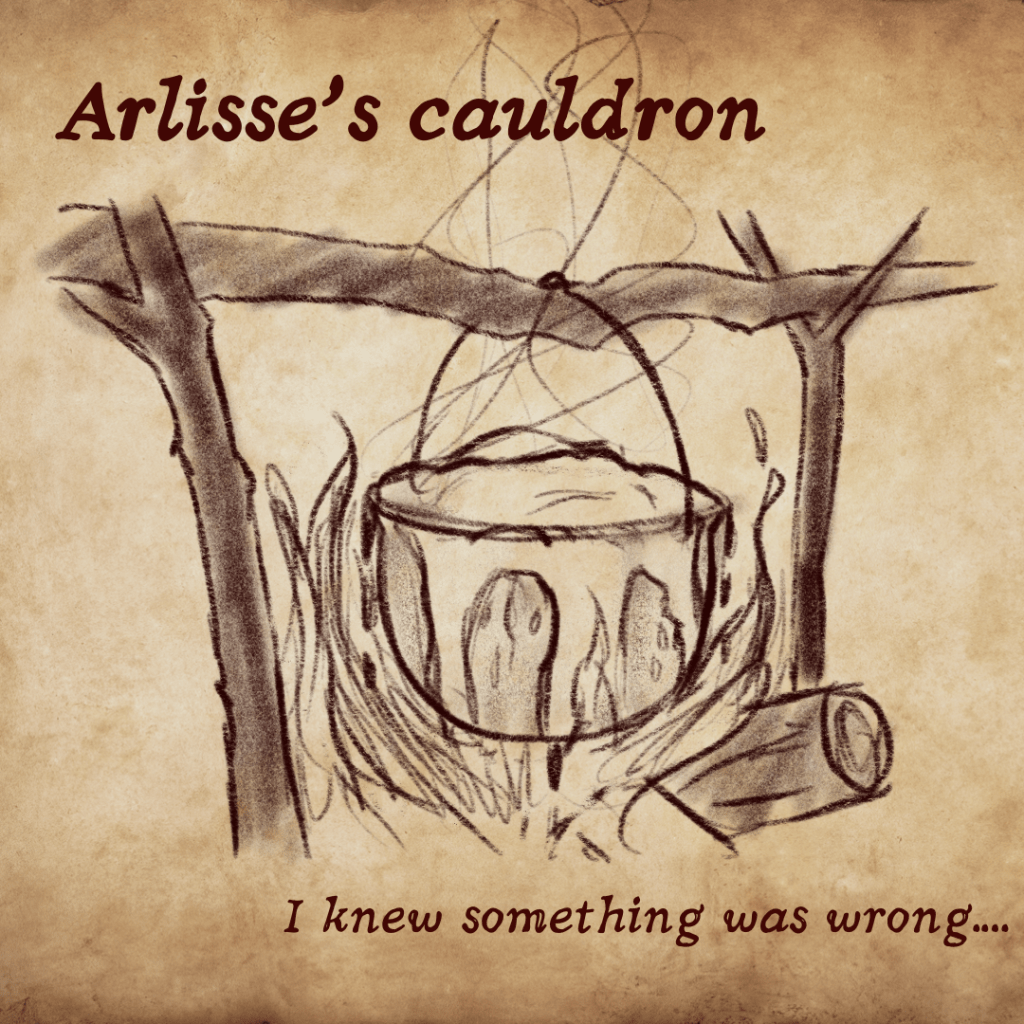
It was the unmistakable work of a corvil: the great blackbirds of legend, elusive and secretive; dark creatures of terrible intelligence and fury. The corvil was gone now, vanished into the night. And so was Sarsha’s silver family necklace, somehow plucked from her grip in the chaos.
After removing the arrow and treating the wound, Sarsha came down the cliff and crossed the river at a shallow point. She was one step from the opposite bank—one step across the border and into Faela—when she stopped. She hesitated. She thought awhile. Then she turned around, and went home.
A home she had chosen. Not one she had fled to. A home that had saved her in her most dire moment. A home that needed her protection and care just as well, even if it thankless, dirty, and could risk her very life. A home where the King would know her as the Riverbird Traitor. A home that needed her as much as she needed it.
This, Arlisse explained, was the way of the riverbird. She knew my answer—we both did—even before the end of the story. I could have done the work, but I couldn’t live the life. The brutality of Boulderbridge—how those townsfolk butchered those men—scared the hundred hells out of me, and still does. But most importantly of all, the riverlands were not my home. Nor could I give it the sacred duty and bond it deserved.
But this didn’t have to be the end. I’d learned at least that much as a hatchling. There was not a way forward for me in the riverlands, true. But there was a way out of it and this mess I’d created of my life.
And I would find it.
When Rand asked for a hand in marriage and revealed himself Roland Craythe—known by the realm as Roland the Righteous and King of the Rivers—Sarsha did what few women would do.
She declined.
Not because she had finally made the riverlands her home. Indeed, had Roland been honest from the beginning, things may have gone differently. But he hadn’t. He’d fabricated all the details and stories of his messenger life. Roland defended these lies, claiming that he’d wanted to see his country from the eyes of the commonfolk, roaming the riverlands with a disguise and a cover story. A protection. But Sarsha had fallen in love with a messenger, not a king. And even if you believe love had nothing to do with any of it, Sarsha desired to reclaim the mantle of Lady Marwood. Not to become one of Roland’s wives.
Saying “no” to a king, however, is rarely a safe affair.
Roland asked her once more. When she refused a second time, he withdrew without another word. Several days later, he returned to Sarsha with a dark mood that simmered in his eyes and twitched on his lips. He’d asked around the local town and had learned her identity, too. She was a hypocrite, he claimed, judging him for falsehood while hiding away her own—and look how she still clung to her family’s silver necklace! Let us forget this nonsense, he said, and move on. When she was a royal wife, he would restore her lands and title to her.
It was nonsense, Sarsha agreed, and turned him down a third time.
The riverlands was not her true home, but it was more of one than what Roland offered.
I understood Sarsha’s decision a little better when my errand girl duties took me to the local village, Boulderbridge. Arlisse sent me to fetch a few things easier to buy than to make herself. She did not give me money—a fact I did not realize until I was standing in front of the village baker, having just put my hands on a loaf of bread. But when I mentioned it was for Arlisse, the baker laughed and handed me two loaves.
Similar stories for the potter and his jars of clay, the blacksmith with his nails, the tailor with his twine. Each offered their wares with the fervor of someone repaying a deep debt—not a sinister one, but one for which they are sincerely grateful. Boulderbridge, it seemed, cherished Arlisse as Sarsha’s village cherished her.
Not everyone, though. My fealty to Arlisse attracted a few scowls and suspicious glares. She had warned me of these townsfolk—people who suspected her and all riverbirds as distrustful wild women. True, not all riverbirds were (and are) selfless saints, and some had even gone mad or rogue. But more had lost their lives for imagined crimes and curses. Even with most townsfolk appreciating their work, there were—and always will be—those who believe them cousins to willow witches, or daughters of the Raven.
Perhaps that was what Roland believed after Sarsha spurned him thrice. He returned some time later and put her river hut to the torch, along with the surrounding wilds. Sarsha, luckily, was out foraging, but by the time she came home, only a field of embers and ash remained. Her townsfolk had turned up as well, drawn by the flames and outraged at the deed. Some mourned with her, offering her a place to stay, but instead Sarsha gathered what little she had left and struck out into the wilds.
She wanted to see the old crone, the one who had first taken her in. What Sarsha’s purpose was, we shall never know. When she arrived and the old crone came out to greet her, a figure stepped out of the shadows of the hut. Not the king, but one of his assassins. The figure plunged a blade into the old crone, who mouthed a scramble of words before collapsing facedown in the mud.
Sarsha screamed and fled into the wilds. How had the assassin found her? How had they hidden from the old crone? And how, Sarsha soon saw, were they able to keep up with her across the untamed riverlands? One thing, however, was certain: the assassin would eventually catch her.
Thankfully, nobody from Boulderbridge followed me back home. My hackles didn’t raise until I arrived at Arlisse’s river hut, where I noticed several things wrong at once. The door was shut. No birdsong. The outdoor cauldron frothed over its rim and onto the embers, making them hiss.
Then someone kicked me from behind, sending me tumbling to the ground. I gasped, winced, spat out grimy spittle. The hut’s door opened. I looked up to see three men emerge, dragging Arlisse out by her wrists and tufts of her hair. They’d bound her up and gagged her. Before I could call out, the man behind me kicked my ribs, sending me rolling and wheezing across the muddy earth. I turned and looked up into the eyes of my attacker.
The dusty man from the crossroads.
